Elevator Pitch Examples You Can Copy and Adapt Fast
Summary
The best elevator pitch examples share four parts: who you are, what you fix, one proof point, and a clear next step. A 30-second pitch is only about 70 words, so cut anything generic. This guide gives you word-for-word scripts for interviews, networking events, freelance clients and product pitches, a test to catch jargon, and a four-step routine for drafting and adapting your pitch with an AI assistant.
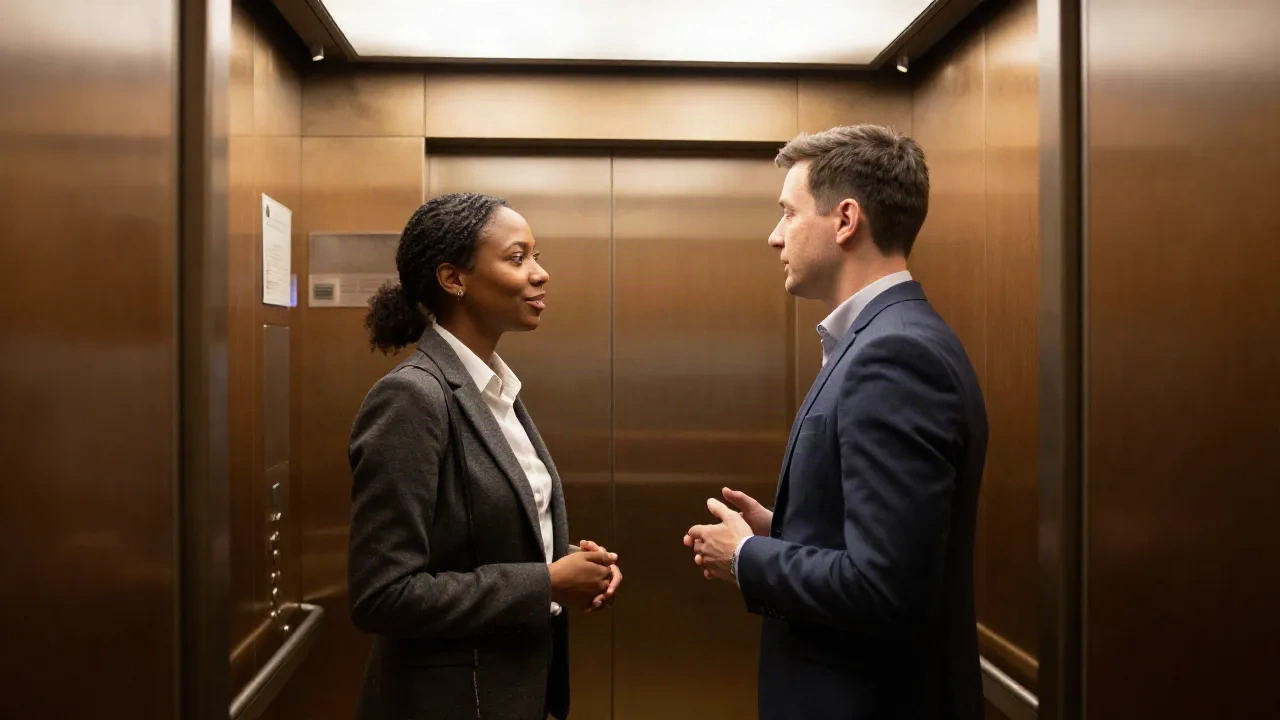
You have 30 seconds with someone who could change your week, and "so, what do you do?" is already out of their mouth. The best elevator pitch examples all follow the same shape: who you are, what you fix, one proof point, one ask. Everything below is built on that shape, with word-for-word pitches you can copy and bend to your own situation.
What does a 30-second elevator pitch actually need?
Four parts. An introduction, a plain explanation of what you do, the one thing that sets you apart, and a next step. Grammarly's guide lands on the same four and suggests 30 to 60 seconds, or roughly 50 to 200 words.
Most people speak at around 130 to 150 words a minute. So a true 30-second pitch is 65 to 75 words, about five sentences. That is shorter than it feels on paper.
The part people skip is the ask. Without it, the listener nods, says "interesting" and the conversation ends at the next floor.
Which elevator pitch example fits a job interview?
Interviewers open with "tell me about yourself", and that is a pitch slot in disguise. Keep it to your role, one result, and what you want next.
"I'm Dana, a content marketer who spent the last three years running a 12-person editorial calendar for a B2B software company. Last year I rebuilt our onboarding emails and lifted trial-to-paid conversion from 9% to 13%. I'm looking for a team that treats email as a product, which is why this role caught my eye."
Count the moving parts. Name and role, one number, one stated preference. Nothing about "passion" or "team player".
Career changers need one extra move: bridge the old job to the new one.
"I spent six years in customer support, answering about 80 tickets a day, so I know what confused customers actually write. I'm moving into UX writing, and last quarter I rewrote our 20 most-viewed help articles, which cut repeat tickets on those topics by a fifth. I'd like to bring that to a product team."
The bridge is the second sentence. It turns a past job into the reason you are good at the next one, instead of an apology for the gap.
Swap the numbers for your own. If you do not have a conversion figure, use a time saved, a volume handled, or a deadline met. A vague claim sounds like every other candidate in the queue.
What does a networking pitch sound like at a real event?
Different job. You are not asking for anything yet, you are giving the other person a hook to ask you a question.
"Hi, I'm Marcus. I write product descriptions and category pages for online shops, mostly in home and garden. The thing I'm known for is turning a 40-product catalogue into copy that sounds like one person wrote it. What brings you to this event?"
Notice it ends with a question, not a request. That is deliberate. A pitch at a coffee station should lead to a second sentence from the other person, because that is when the conversation starts.
Big Interview's guide makes the same point: a pitch that sounds scripted is a pitch that gets tuned out. Leave a gap for the other person to talk.
What about a startup or freelance pitch to a potential client?
Here the proof point matters most. The listener is deciding in a few seconds whether you are worth a calendar slot.
"I help small ecommerce brands fix their abandoned-cart emails. Most of my clients have three emails in the sequence and none of them sound like the brand. I rewrite the sequence in a week, then we test it against what you have now. If you send me your current flow, I'll tell you the two changes I'd make first, free."
Three things work. It names a specific customer. It describes the problem in the customer's words. And the ask is small enough to say yes to in a hallway.
A freelance pitch fails when it lists services. "Copywriting, editing, strategy, social" tells the listener nothing about what they would buy.
How do you write a pitch for a product or a founder story?
Start with the problem, not the product. People remember a situation they recognise long before they remember a feature.
"Every week, a freelance writer loses about two hours rewriting the same polite email in slightly different tones. We built a plug-in that does a first pass in the tone you pick, so you edit instead of starting over. We're onboarding 50 freelancers this month. Would you try it on one real email?"
Problem, fix, scale, ask. Four sentences, about 60 words. The "50 freelancers this month" line gives the ask a reason to be now, not someday.
If your product pitch needs the word "platform" to make sense, cut it and say what a user does with it.

Why do most pitches sound the same, and how do you avoid it?
Three habits make a pitch forgettable.
First, jargon. "Synergistic solutions for seamless integration" means nothing to anyone, and everyone has heard some version of it. Second, a generic claim, such as "I help companies grow". Third, no differentiator: if a competitor could say your pitch word for word, it is not a pitch yet.
The fix is one standout point. Pick the one fact about your work that a listener could repeat to someone else, and build around it.
Delivery is the other half. Slow down, because nerves push most people to talk faster than they think. Look at the person, not at the floor, and let one sentence finish before you start the next.
Do not recite it like a script either. If the listener interrupts with a question, answer it and pick the thread back up. A pitch that survives an interruption is one you actually know.
A quick test: say the pitch to a friend outside your industry. If they cannot tell you what you do afterwards, rewrite it.
Can an AI writing assistant help with an elevator pitch?
Yes, for the first draft and for the versions. No, for the substance.
An assistant cannot know your real result, your real client or the thing you do that nobody else does. If you feed it a vague description, you get a vague pitch back, polished. What it does well is produce a first jet in a minute, so you have something to cut instead of a blank page.
Here is the routine that works for most people:
Write three rough bullets: who you help, what you fix, your best number.
Ask the assistant for a 30-second version and a 60-second version.
Cut anything you would not say out loud to a stranger.
Read it aloud, with a timer, and fix whatever makes you stumble.
For tone and phrasing, a rewrite tool is more useful than a generator. Rephrasing tools such as Wordtune gives you three or four ways to say the same sentence, and you pick the one that sounds like you.
Where it does not replace anything: the delivery. A pitch that reads well and sounds stiff is still stiff. Say it ten times before the event, not once.
How do you adapt one pitch to three audiences?
Keep a base version and change one line. The base carries your name, what you do and your proof. The swap is the last sentence.
For a recruiter, the last line is what you want next: "I'm looking for a role where I own the email program end to end." For a peer at a conference, it is a question about them. For a prospective client, it is a small offer: "I can send you a two-line teardown of your current flow."
An assistant is handy here, because adapting is repetitive work. Paste your base pitch, state the audience, and ask for the closing line only. You get four candidates in seconds, and picking one takes 20.
Keep the original and the variants in one note. Before an event, read through them once and choose the one that fits the room.
What should you do right after the pitch?
Follow up inside 24 hours. A short message that mentions something specific from the conversation does more than a long one.
Something like: "Good meeting you at the coffee station. You mentioned your team is rewriting its onboarding flow. Here is the article I mentioned, and I'm happy to talk through it next week."
Two sentences. A reference to something real, and a next step with a date. If you wrote down the ask in your pitch, the follow-up writes itself.
Which pitch should you actually use tomorrow?
If you have one pitch to prepare, prepare the networking one: name, what you fix, one proof, a closing question. It works in a lift, at a conference and in the first minute of an interview.
Write it in five sentences, time it, then trim until it fits in 30 seconds. Use an AI assistant to get the first draft and the variants, and do the final edit with your own voice.