How to Write an Objective Summary: Tips and Examples
Summary
An objective summary captures the core argument and key supporting points of a source text without adding your own opinion or interpretation. It answers three questions: what is the text about, what does it claim, and what evidence does it use to support that claim. A clear objective summary runs 10 to 15 percent of the original length and passes one test: someone who has not read the source should finish it knowing exactly what the text says.

You have a 40-page report on your desk and a meeting in 25 minutes. You need to communicate what it says, not what you make of it. That is where an objective summary earns its keep.
An objective summary restates a text's main argument and key supporting points accurately, without layering in your own interpretation, opinion, or conclusions. It is a neutral account of what the source says, not what you think about what the source says. That distinction sounds minor until you hand a summary to a colleague and realise half of what you wrote was your reaction to the text, not the text itself.
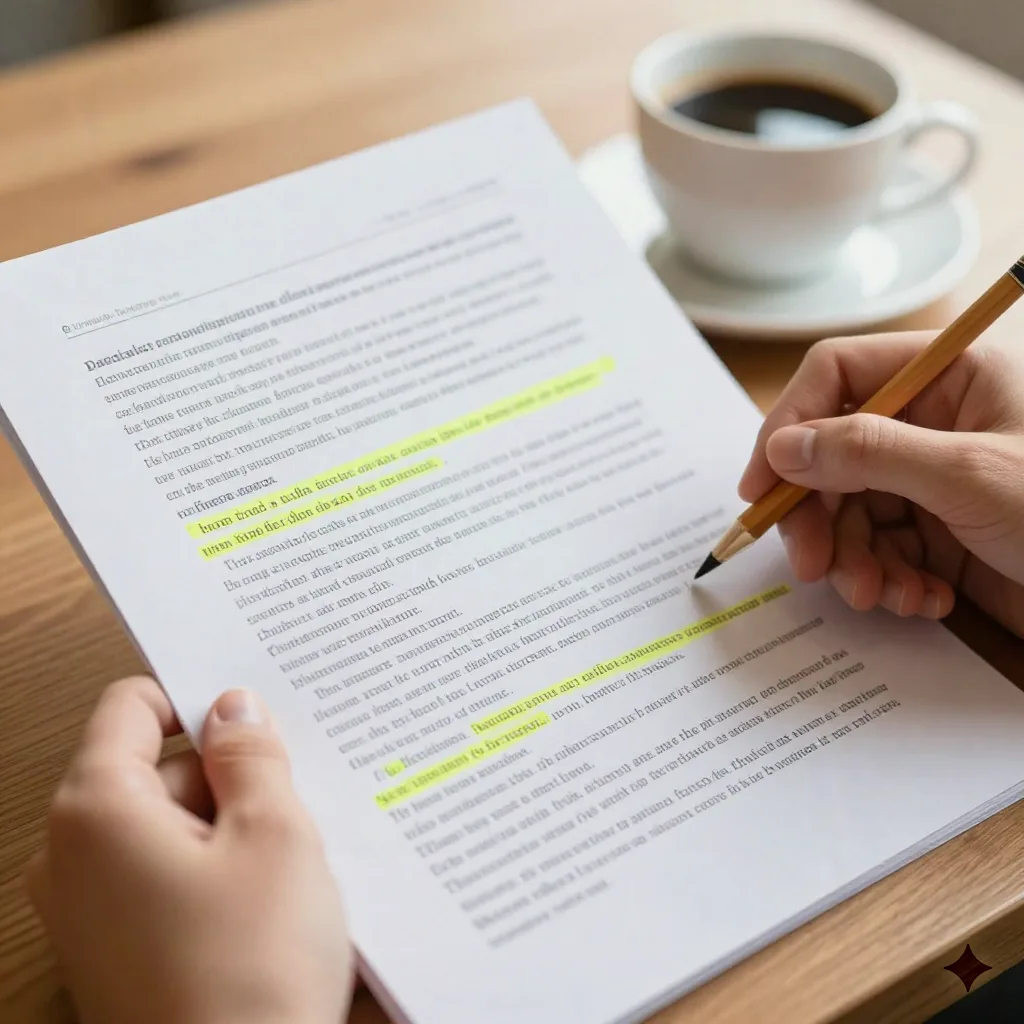
What Makes a Summary Objective Rather Than Evaluative
The line between objective and evaluative is easier to see than to hold when you are writing quickly.
An objective summary says: The report argues that remote teams show higher output when given asynchronous communication norms, citing data from 1,200 employees across four sectors.
An evaluative summary says: The report makes a compelling case that remote teams are more productive, which confirms what most people already suspected.
The second version adds "compelling case" (your judgment), "confirms" (your framing), and "what most people already suspected" (your interpretation). None of that is in the source text. Strip all of it out and you have an objective summary.
Three markers of evaluative language to watch for:
Adjectives that signal your approval or disapproval: compelling, flawed, thorough, shallow
Verbs that imply success or failure: proves, fails to account for, neglects, demonstrates convincingly
Comparisons you are making, not ones the text makes
The Four-Step Method That Holds Up Under Pressure
This is the method I use with client briefs when turnaround is tight. It works on articles, research reports, legal documents, and meeting transcripts.
Step 1: Read once for the main claim. Before annotating anything, finish the whole text. Your goal is to land on a single sentence that answers: what is the author's central argument or main point? Write it down before moving on.
Step 2: Identify the supporting structure. Go back through the text and mark the three to five sections or arguments that carry the main claim. Not every paragraph. Not every example. The load-bearing parts.
Step 3: Draft in your own words, source order. Write your summary in the same order as the original text. This is not a rule for elegance; it is a reliability check. If your summary jumps around, you have probably started editorialising.
Step 4: Run the opinion audit. Read your draft and underline every word that reflects your view rather than the text's view. If you find more than two underlined phrases, revise before sending.

How Long Should an Objective Summary Actually Be
Most writing guides say 10 to 15 percent of the original text. At the usage, that gives you a reasonable working range:
1,000-word article: 100 to 150 words
10-page report: roughly one page
40-page document: three to four pages
The more useful question is: can the reader who has not seen the source understand exactly what it argues after reading your summary? If not, it is too short. If your summary requires reading the original to make sense of, start again.
One thing that reliably makes summaries run long: including too much supporting evidence. A good objective summary names what type of evidence the text uses (survey data, case studies, experimental results) without reproducing the data itself. The exception is when a specific number is the point, like a percentage or a timeline.
Where an AI Assistant Saves Time and Where It Does Not
I have been using AI writing tools in my workflow since 2022, and the honest answer on objective summaries is: AI is good at the first pass, less reliable on the opinion audit.
What an AI assistant does well:
Pulling the main claim from a long document in under 30 seconds
Maintaining source order in the summary structure
Stripping filler from its own draft when you prompt it to
What still needs a human:
Judging whether a phrase is evaluative or merely descriptive
Knowing when a supporting point is actually load-bearing versus illustrative
Catching cases where the AI has summarised what the text implies rather than what it states
At the usage, the workflow that saves the most time is: let the assistant produce the first-pass summary, then spend five minutes on the opinion audit yourself. That combination runs about 8 minutes total on a 2,000-word article. Doing it manually takes 20 to 25 minutes on average.
Three cases where IA helps most:
Meeting transcripts where the signal-to-noise ratio is low
Technical reports where scanning for structure takes longer than reading for content
Client briefs where you need to extract the decision-relevant points before a call

The Mistakes That Keep Appearing in Objective Summaries
After reviewing summaries from clients and students over several years, the same patterns come up.
Quoting instead of summarising. If more than 10 percent of your summary is in quotation marks, you are not summarising, you are excerpting. Quotes are fine for emphasis but they are not a substitute for paraphrase.
Starting with context instead of the main claim. "In this report, the authors explore the question of..." is not an objective summary opening. It is a delay tactic. Start with the main claim.
Mixing the summary with your notes. If you are working from annotated pages, it is easy to transfer your marginal comments into the summary draft. Keep two documents separate: one for notes, one for the summary.
Treating absence as a finding. The text does not mention X is not something to include in an objective summary. You are summarising what is there, not auditing what is missing.
Objective Summary vs Executive Summary: Not the Same Thing
These two formats get used interchangeably and they should not.
An executive summary is persuasive. It is designed to help a decision-maker act. It includes recommendations, highlights implications, and often proposes next steps. It reflects the author's judgment about what matters most.
An objective summary is neutral. It does not recommend, evaluate, or prioritise. It reports.
When you are writing for a stakeholder who needs to make a decision, you want an executive summary. When you are writing for a colleague who needs to understand a source text before a meeting, you want an objective summary.
The confusion costs time. I have seen briefs go back twice because a client asked for a summary and received an executive summary instead, complete with recommendations they had not asked for and were not ready to act on.
What to Do When the Source Text is Not Neutral
Some texts argue a position strongly, use loaded language, or present contested claims as fact. Summarising them objectively is harder because you have to represent what the text says without importing its rhetorical stance into your summary.
The rule is: you can name the text's perspective without adopting it.
The report argues that current privacy regulations are insufficient and presents three cases to support this position. That is objective. You have flagged that it is an argument, not established fact.
The report reveals that current privacy regulations are insufficient. That is not objective. "Reveals" implies you accept the claim as true.
Verbs matter here more than anywhere else in the summary. Use: argues, claims, asserts, presents, identifies, describes, notes. Avoid: proves, shows, reveals, confirms, demonstrates.
This matters especially in professional settings where the summary travels further than the source document. A brief that goes from one team to another, from one department to a board, picks up credibility as it moves. If you have imported the source's rhetorical stance into your summary, that stance now appears to be your organisation's position, not the original author's.
When the source text is highly partisan or methodologically contested, it is worth adding one framing sentence at the top: The following is a summary of [author/organisation]'s position as stated in [document name]. That sentence does the work of flagging the source's perspective without requiring you to evaluate it in the summary itself.
How to Use This in Your Daily Workflow
Most professionals need objective summaries more often than they realise, they just call them by other names. A meeting debrief where you report what was decided, not what you thought of the decisions. A document handover where you brief a colleague before they take over. A client update where you summarise a supplier's proposal without steering the client's reaction.
In each of these cases, the four-step method applies without modification. What changes is the format: a meeting debrief might be three bullet points, a document handover might be half a page, a client update might be two paragraphs in an email.
The format adapts. The principle does not: report what the source says, in the source's order, without your interpretation.
A practical way to build this as a habit is to keep two separate notes open when you are reading a document. One for your reactions and questions, one for the source's actual content. The second note becomes your summary draft. The first note is for your own thinking, your follow-up questions, your doubts. Keeping them separate removes most of the editorialising from the summary before you have written a single sentence.
At the usage, this takes about two extra minutes to set up and removes one full revision cycle from the summary process.
When You Are Ready to Move Faster
The method above is repeatable on any text. Once it is automatic, a 1,000-word article takes about 8 minutes from first read to finished summary. A 10-page report takes 20 to 30 minutes. Those numbers hold whether you are summarising solo or using an AI assistant for the first-pass draft.
The faster you get at the opinion audit, the faster the whole process goes. That is the skill worth building: not reading faster, but catching your own editorialising before it lands in the final text.